

Here's a straight translation:
"Svanidze Olive" opens a new, modern olive processing plant — biological production, energy efficiency, and the highest oil quality, placing Georgia on the international map
In the Taribana valley of Georgia's Kakheti region, "Svanidze Olive" has officially opened a new, modern olive processing plant — a project that sets an entirely new standard in the history of Georgian olive oil production.
The new facility stands out for its eco-friendly approach and innovative technology — here it produces the highest-quality Extra Virgin olive oil and marinades.
The plant is equipped with machinery from the world's leading brands — Italian and German production systems that comply with European standards. The plant is designed to process up to 150 tonnes of fruit per day, supporting not only the growth of local production but also the expansion of exports.
One of the plant's main advantages is its location — in the immediate vicinity of the olive groves. This makes it possible to begin the pressing process within just one hour of harvesting, significantly reducing the acidity index and ensuring the production of the highest-quality oil, which retains all of its natural vitamins, antioxidants, and aromatic qualities.
As part of the project, up to 150 new seasonal jobs were created, most of which were filled by the local population. The plant will make a significant contribution to strengthening the regional economy and to raising the competitiveness of Georgian agricultural production on the international market.
The opening ceremony was attended by representatives of the government, the diplomatic corps, international organizations, and the private sector.
"This plant is not merely a space for producing olive oil — it is a demonstration of Georgia's capability to produce the highest-quality product through an eco-friendly approach and innovative technology, powered solely by wood energy, by way of natural production. The facility will serve not only the Svanidze groves but will also take in the olive harvest of farmers across all of Georgia. Our goal is to make Georgia one of the leading producers on the world olive map," said Giorgi Svanidze, founder of "Svanidze Olive," at the plant's opening.
We remind you that the founder of Georgian olive cultivation is Giorgi Svanidze, who in 2009 planted the first saplings on the fertile soil of Kakheti, together with partners.
Since 2019, Georgia has been a member country of the UN organization "International Olive Council," which provides significant support for the global development of the olive sector and the adoption of international standards. Giorgi Svanidze was twice elected president of this organization, which is an important step in positioning Georgia's olive production on the international stage.


_4b914be9ed7a71853704328274dc0fad.jpeg)

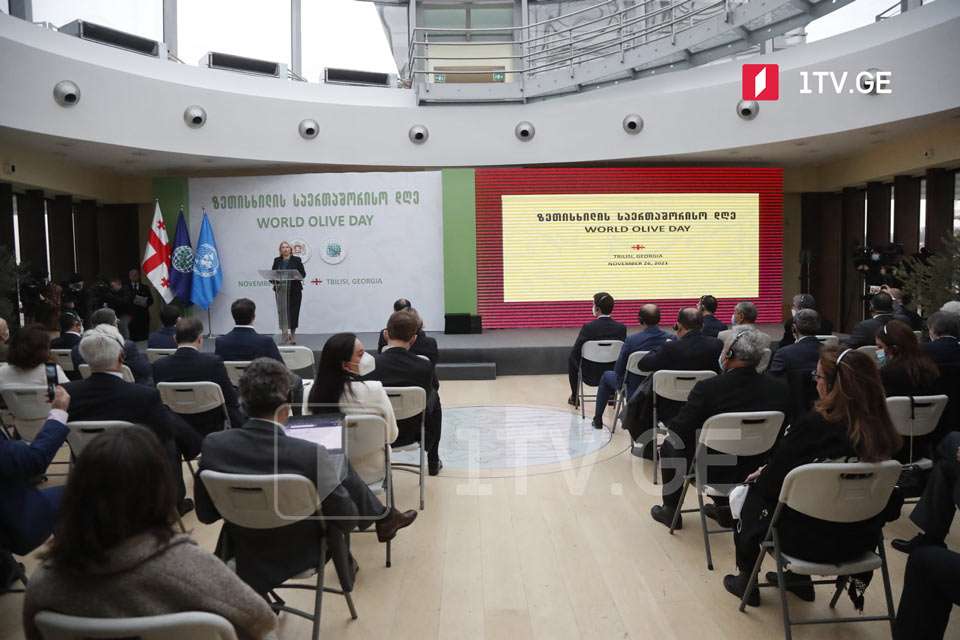
The Minister of Environmental Protection and Agriculture, Levan Davitashvili, congratulated the members of the International Olive Council (IOC) on World Olive Day.
As the Minister noted, Georgia has great potential for olive production. Establishing olive plantations will play a significant role in the country's economic stimulation and in employing the local population.
"The olive is a crop with very great potential in the country. We are actively supporting the development of the fruit-growing sector. Within the framework of the 'Plant the Future' program, we have already established more than 15,000 [hectares] of intensive orchards, including olive plantations among them. We plan to create an olive nursery in Georgia in order to accelerate the establishment of olive plantations and to use locally produced olive saplings. In addition, quality control of the products already produced will take place in a state laboratory. The state is ready to support the creation of additional enterprises through co-financing," noted Levan Davitashvili.
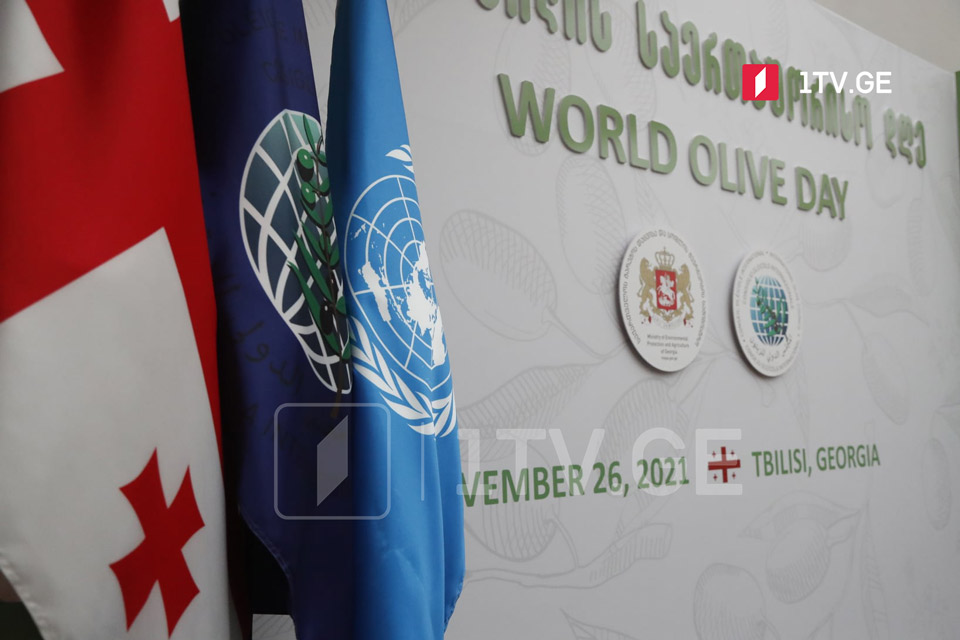
As part of the event, participants discussed the challenges and opportunities of the olive sector; they addressed issues related to financial, economic, technological, and environmental conditions. World Olive Day was held in Georgia within the framework of the 114th session of the International Olive Council and the 57th meeting of the Advisory Council.
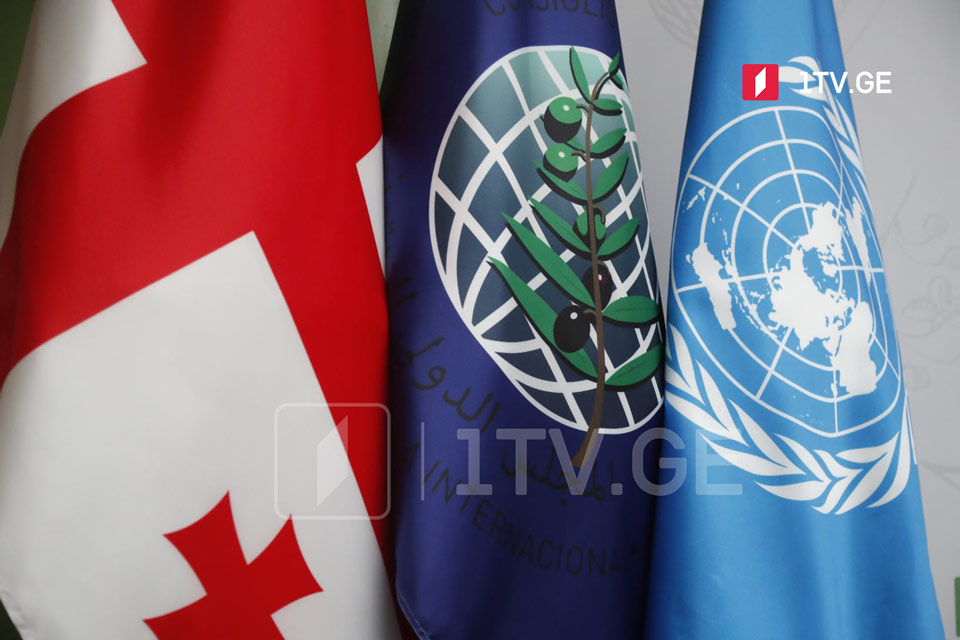
The events were held with the support of the Ministry of Environmental Protection and Agriculture, under the aegis of UNESCO, and on the initiative of the International Olive Council. Georgia joined the International Olive Council in 2019 and became the council's chairing country in 2020.
The information is released by the Ministry of Environmental Protection and Agriculture.


As Giorgi Svanidze, founder of "Svanidze Olive Oil," stated on the program "Business with Rustavi 2," due to the olive shortage on the market, the price has doubled — rising from 3–3.5 dollars to 7 dollars over the past two years.
According to him, Turkey is one of the markets that supplies the world with olives, accounting for up to 20% of total coverage. However, Svanidze argues that the country will not be able to fully supply the world and eliminate the shortage.
"I think that if the situation continues like this, we should likely expect another 20–25% increase in prices. However, I anticipate that in the coming year and the periods thereafter, the situation will improve," Svanidze states.
As for the Georgian olive sector, he says that the company's olive volumes are increasing every year. This year, the company "Svanidze Olive Oil" established 300 hectares of olive plantations.
Svanidze estimates that over the next five years, 70–80% of imported olives on the domestic market will be replaced by Georgian olives.
For reference, Europe is facing a shortage of olive oil, and product stocks are running out. For the second year in a row, the cause is cited as poor harvests due to drought and unusual hailstorms. Historically, Spain supplied more than half of the world, but producers have now turned to South America for imports. At the same time, Turkey claims it can eliminate Europe's shortage, though for this to happen, restrictions must first be lifted.


Europe is facing an olive shortage, according to information published by The Guardian. The outlet reports that the cause is climatic conditions. According to their information, businesses are being forced to import olives from South America. Representatives of the International Olive Council are also making discouraging forecasts, stating that this year's harvest will decline by 2.4 million tons — a significant drop compared to last year, falling considerably short of the growing global demand.
As Giorgi Svanidze, founder of the company "Svanidze Olive Oil" and President of the [International] Olive Council, states, Georgia's harvest faces no threat this year, and the volume of the country's yield will be satisfactory. According to him, more than 200 tons of olives will be received from farmers this year.
"We began establishing our plantations in 2009. Since then, the trees have been maturing, and in recent years we have been developing plantations on a larger scale, with the harvest growing year over year. I believe that in the coming years, fruit-bearing will increase and we will reach an even larger harvest. In total, we expect more than 200 tons of harvest from growers and farmers this year. The yield in the orchards is normal," says Giorgi Svanidze.
As for prices, against the backdrop of the crisis in Europe, most olive-producing countries are announcing significant price increases. Giorgi Svanidze states that there will be no significant changes in this regard in Georgia, and prices on the local market will be maintained. According to him, this year the delivery price for olives will be 1.5–2 GEL.
"Last year, the price of olives on the global market rose by 35%. This year, there will likely be a 30–35% increase as well. In Europe and the Mediterranean countries, the olive harvest has come in at reduced volumes compared to 5–10 years ago. Drought and unstable weather are greatly hindering the olive harvest. I believe Georgia and our territories are becoming favorable for cultivating olive crops. We are trying to maintain the same price on the Georgian market so that the price of olives does not rise, though export prices will likely match whatever prices prevail on the global market. This year we will purchase a kilogram of olives for 1.5 GEL, depending on the quality of the olives. The delivery price may be 1.8 GEL. However, the average price will be between 1.5 and 2 GEL," states Giorgi Svanidze.
Giorgi Svanidze says that there is strong interest from investors in Georgia regarding the establishment of olive orchards and the construction of processing plants. According to him, at this stage there is interest from 3–4 countries in launching an olive business in Georgia.

"We can confidently say that the olive industry has established its place both here and in the world," stated Giorgi Svanidze, President of the International Olive Council.
"First we brought in the saplings, we created the plantations; then, once we received the harvest, we built the processing plant; and now we have established the nursery.
In parallel, we obtained the international global certificate, with which Georgian olives can today knock on the door of any country and go to export at quite a high price. Once this cycle was created, it became fully operational, and we can confidently say that the olive industry has established its place both here and in the world. Imagine — those countries that don't produce olives and are importers (out of 300 countries, only 47 produce them) — when Georgian olives are mentioned, everyone pricks up their ears and asks: is this that remarkable olive? It's excellent quality," stated Giorgi Svanidze.

Georgia is set to open its first nursery that propagates olives through cuttings and grafting. I can already confidently tell you that we produce half a million seedlings every year, and within the next two years — one million. We will no longer need to import seedlings from abroad. What's more, these seedlings, grown in Georgia, are far stronger and accustomed to this climate. Beyond that, we stress some of the seedlings from the very beginning so that they grow stronger and require less watering. If, over the next five years, we can produce somewhere around 3–4 million seedlings, and 7–8 million over the following ten years, we will essentially transform the Dedoplistsqaro and Sighnaghi districts — Kakheti as a whole, primarily — into a little Andalusia, where much of the land today lies bare. The seedling we are working on today will give us the ability to produce the highest-quality olives in Georgia. Then, over the next five years, this production will allow us to replace, with natural, high-quality Georgian olive oil, the imported oil that today we honestly don't even know which country it comes from or what quality it is," Giorgi Svanidze stated.

The company "Svanidze Olive Oil" plans to expand its factory's production threefold. The main reason for this is growing demand in both local and international markets.
As the company's founder, Giorgi Svanidze, states, the quality of olives grown in Georgia is quite high.
As is known, Georgian oil first appeared on the market in 2016 and captured 10–12% of the local market; today, approximately 20–22% of imported products have been replaced.
On March 26, 2016, the first "Svanidze Olive Oil" processing factory was opened in the village of Saqobo, Sighnaghi district.
The olive production facility is equipped with ultra-modern technology, which enables the manufacture of the highest-quality, competitive Georgian products. The factory's capacity allows for the production of several hundred tons of olive marinade and premium-quality extra virgin olive oil per season.
The company "Svanidze Olive Oil" made a million-dollar investment, as a result of which a 300-hectare olive plantation (250,000 olive seedlings) was established.


According to Giorgi Svanidze, President of the International Olive Council, it is welcome that Georgia is a member of the International Olive Council — an organization that oversees 90% of the world's olive revenue and 74% of its trade. Therefore, being part of this organization is a step forward for Georgia. He says that Georgia's olive production has only recently begun, and the country genuinely needs markets.
"Imagine — the olive oil produced in Georgia has demonstrated very high quality. Sicilian oil is considered the finest on the global market, and Georgian olive oil has, in fact, matched it by every standard.
This is precisely what allows more investors to become interested in producing this oil in Georgia. It also allows us to enter the global market more easily. We are developing step by step: first there was olive oil, then table olives, and now soap. I believe these volumes will grow. At this stage, we are working on future expansion," Giorgi Svanidze told AIPRESS.

Discover a new Georgian crop — its founding and development, watch a video here:

This year's olive harvest increased 2.5-fold. As Giorgi Svanidze, founder of the company "Svanidze Olive Oil," states, today more farmers and companies are interested in olive cultivation.
The businessman explains that the more plantations are established and the larger the harvest, the more product there will be for the export market as well — allowing major chains such as Carrefour and others to be supplied with Georgian olives.
"This year the weather was very good for olives. We received roughly 2.5 times more olives; we'll be able to state the exact figure by the end of March. The number of olive plantations has grown as well. During the olive harvest, we would open the factory at six in the morning, and farmers would line up to deliver their product. We're glad that people have already begun actively planting olives. Even large companies have now expressed a desire to cultivate this crop. We've already signed several cooperation agreements — for example, with KTW, where we're talking about planting hundreds of hectares of olives, as well as with the Partnership Fund. And we, of course, increase the volume of our planted areas every year," Giorgi Svanidze noted.
According to him, the olive crop has proven successful not only in Kakheti but in other regions as well. Giorgi Svanidze advises farmers to take an interest in this crop.
"Just imagine — this is a thousand-year-old crop. Olives bear fruit for centuries. Planting olives is the kind of endeavor that benefits future generations. Today we find it difficult to negotiate with large chains, because we don't have enough product. The more plantations are established, the more product we will have. It's also worth noting that olives grown in different regions have entirely different flavors. For example, olives grown in Taribana, Sighnaghi, or Baghdati have distinct taste characteristics," Giorgi Svanidze explained.
Svanidze says that for the "Svanidze Olive Oil" company, replacing imports with local products is the top priority; however, since demand is growing and interest in this crop has increased sharply, the first shipment abroad is planned for the autumn.
As is known, Georgian oil first appeared in 2016 and captured 10–12% of the local market; today, approximately 20–22% of imported products have been replaced.
On March 26, 2016, the first "Svanidze Olive Oil" processing factory was opened in the village of Saqobo, Sighnaghi district.
The olive production facility is equipped with ultra-modern technology, which enables the manufacture of the highest-quality, competitive Georgian products. The factory's capacity allows for the production of several hundred tons of olive marinade and premium-quality extra virgin olive oil per season.
For reference, efforts to revive Georgia's olive-growing tradition began with the support of His Holiness the Patriarch and the Georgian diaspora. A multi-million investment was made in this unique project, as a result of which a 300-hectare olive plantation (250,000 olive seedlings) was established.


Businessman Giorgi Svanidze is connected to an unprecedented decision in the 60-year history of the "International Olive Council" — this authoritative UN organization has elected him as its chairman for a second consecutive term.
This success is connected entirely to the results achieved during Giorgi Svanidze's chairmanship and to the Georgian businessman's innovative vision. Under Giorgi Svanidze's leadership, the "International Olive Council" reached previously unseen scales of expansion, with 7 new countries joining the council, among them such large countries of the East as Uzbekistan and Azerbaijan.
The "International Olive Council" was founded 60 years ago by the Spanish royal family. The council unites the world's largest countries, which possess the greatest traditions and volumes of olive cultivation and production — for example, Spain, Italy, Morocco, and Greece. The "International Olive Council" controls 97% of the world's olive business; this organization issues the certificates necessary for the production and sale of olives on the world market, and it also carries out 74% of the world's olive trading.
For Georgia, chairing this council for the second consecutive year is a precondition for new perspectives and for the revival of a new culture in the country's agriculture. The country is given a unique chance to become, after Italy and Spain, the world's third hub of olive production and to supply the countries of East Asia with Georgian and European olives. As for the prospects within the country — olive cultivation and oil production will become comparable in volume to the directions of wine, grapes, and hazelnuts, which automatically means increased jobs and employed people, and growth in exports and investments.
The prospect of Georgia forming as a world hub of olive production emerged after businessman Giorgi Svanidze founded the "Svanidze Olive" company 10 years ago and, with the support of the Ministry of Agriculture, established olive plantations on 100 hectares of land in Kakheti. As it turned out, Georgian olives thrive especially well on Georgian soil, and in quality they surpass olives produced in other countries by various parameters. It was precisely this fact that interested the "International Olive Council," which gave Georgian olives the green light on the world market by awarding them a certificate confirming the highest category of quality, after which the company began exporting Georgian olives. And in Georgia, the 100% share of olive imports was replaced by 25% with Georgian olives.
"For me, as a businessman, it is a very great honor to chair, for a second year, the organization founded by the Spanish royal family, which sets the weather for olive cultivation and trading in the world. Moreover, it is very gratifying that my period of chairmanship, in 2021, will coincide with the council's 60th anniversary. Since Georgia is the chairing country this year, the jubilee will also be held precisely in Georgia. In September–October an assembly will be held, and the largest investors from 50 countries will come to Georgia; they will get acquainted with our country, our culture, and the prospects of olive production, which in the future will be a precondition for attracting solid investments to Georgia and creating new jobs," says Giorgi Svanidze, whose founded company "Georgian Olive" employs more than 300 people and who, even against the backdrop of this pandemic and restrictions, tend to the olive groves established on 100 hectares.
Giorgi Svanidze does not limit himself only to his own olive groves and oil production. He helps and consults everyone — every person or organization — planning to plant olives and to make their own contribution to the revival of this field. He familiarizes himself on-site with the process of olive cultivation — the advice of a person experienced in this field, and simply standing by one's side, is truly invaluable help for beginners.
So, if you intend to revive Georgian olives, if you plan to cultivate this ancient and mystical-divine culture, do not be lazy — visit Giorgi Svanidze's olive groves in Sighnaghi, get advice, and see the place from which a new Georgian history begins — the history of how Georgia became the world's third olive hub.
_b3f3c167bc2549c08c50928c66891a5b.jpeg)
At the initiative of businessman Giorgi Svanidze, Georgia joined the International Olive Council in 2019 — an organization that unites 48 olive-producing countries, representing 97% of the world market. His activity drew such attention that, during 2019–2021, Giorgi Svanidze was elected President of the Council twice. It was precisely during his Council presidency that he established "World Olive Day." Today, Mr. Giorgi Svanidze continues to represent the country on the Council with the title of Honorary Ambassador.
On November 22–23, the International Olive Council held its 61st meeting and 118th plenary session in Madrid. The event was attended by official delegations from olive-producing countries and representatives from the private sector. Present in Madrid was Mr. Giorgi Svanidze, who represents Georgia's olive producers on the Council. He delivered a speech at the event and presented Council members with successful olive projects carried out in Georgia and beyond, as well as the sector's current and future development plans.
Giorgi Svanidze congratulated the public, government representatives, the diplomatic corps, ministers, and sector representatives from various countries around the world on World Olive Day. During the event, participants discussed the olive sector's challenges, opportunities, and achievements, and planned future activities.
It is worth noting that Giorgi Svanidze's name is associated with the establishment of olive cultivation in Georgia, the uniqueness of which lies in introducing and establishing the olive crop in the country. Beyond producing premium-quality oil and marinade products from olives, the foundation of this major undertaking was supporting Georgia's agricultural sector, developing the region, and strengthening Georgian farmers.
"Svanidze Olive Oil" production comprises 100% natural extra virgin olive oil and marinades, made from the olive harvest gathered in Georgia. The olive products are presented on the market under the "Svanidze" brand and are available in Georgia's retail chains: Agrohub, Carrefour, Fresco, and Smart. The expansion of Giorgi Svanidze's Georgian olive product range, exports, and large-scale entry into retail chains are part of this year's and future plans.
